City Competitiveness: How Global Cities Are Ranked
In Plain English
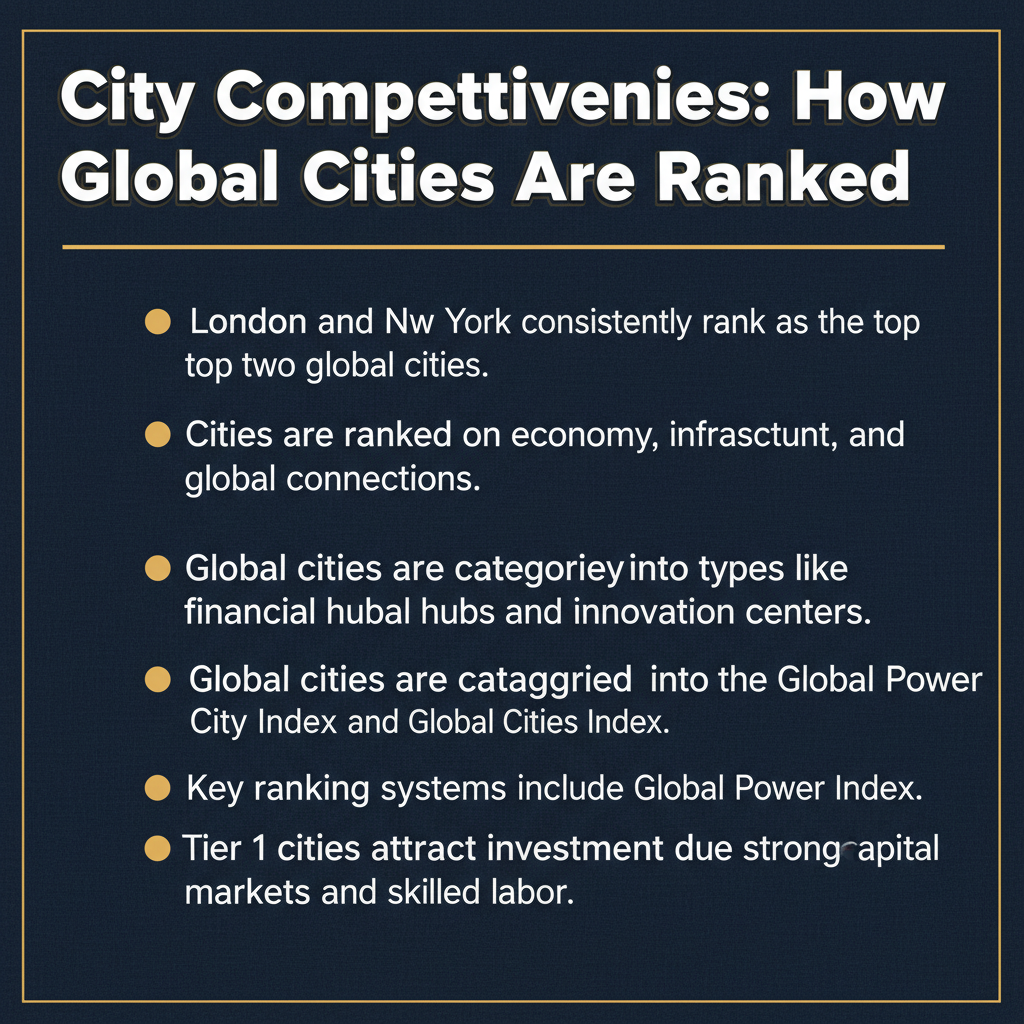
This article explains how experts measure and rank cities around the world based on their global influence. The research suggests that a city's competitiveness depends on its economy, infrastructure, talent, and connections to other major urban centers. Some cities are financial powerhouses, while others specialize in trade, culture, or innovation. The way cities are ranked affects where governments and companies choose to invest. This matters because it shapes job opportunities, living standards, and regional influence over time.
What Is the Global Hierarchy of Cities?
The global hierarchy of cities organizes urban centers by their influence in economic, political, cultural, and infrastructural networks. Top-tier cities such as London, New York, and Tokyo function as command and control nodes in the global economy, hosting major financial institutions, multinational headquarters, and international organizations. Intermediate-tier cities play regionally significant roles, while lower-tier cities are often nationally or locally oriented. This hierarchy is not static; shifts in economic power, technological adoption, and geopolitical alignment can elevate or diminish a city’s standing over time. The analysis suggests that connectivity, innovation capacity, and institutional quality are key determinants of hierarchical position.
Major Global City Ranking Systems Compared
Several institutions publish influential city competitiveness indices, each with distinct methodologies. The Mori Memorial Foundation’s Global Power City Index (GPCI) evaluates cities across six functions: economy, research and development, cultural interaction, livability, environment, and accessibility. Kearney’s Global Cities Index emphasizes business activity, human capital, information exchange, and political engagement. The GaWC network at Loughborough University classifies cities based on the presence and reach of advanced producer service firms. Meanwhile, the IMD World Competitiveness Ranking focuses on national-level economic performance, often conflating country and city outcomes. These differing frameworks yield divergent results, underscoring the importance of understanding what each index measures.
What Are the 7 Types of Global Cities?
According to research by institutions like Brookings, global cities can be categorized into seven types based on their primary functions: financial hubs (e.g., New York, London), innovation centers (e.g., San Francisco, Boston), manufacturing gateways (e.g., Shenzhen, Rotterdam), trading entrepôts (e.g., Singapore, Dubai), administrative capitals (e.g., Washington D.C., Berlin), cultural metropolises (e.g., Paris, Tokyo), and emerging gateway cities (e.g., Nairobi, Bogotá). This typology helps explain why certain cities excel in specific dimensions of competitiveness while lagging in others. The classification suggests that policy strategies should align with a city’s functional identity rather than pursue generic 'global city' status.
What Defines Tier 1 Global Cities?
Tier 1 global cities are those consistently ranked at the top across multiple indices due to their deep capital markets, high-quality infrastructure, skilled labor pools, and institutional stability. These cities attract disproportionate levels of foreign direct investment, talent, and diplomatic representation. Examples include London, New York, Tokyo, Paris, and Singapore. Their status is reinforced by network effects: the more global actors locate there, the more valuable the location becomes. Research indicates that Tier 1 status is difficult to achieve without sustained policy coherence and openness to global flows of people, capital, and ideas.
Which Two Cities Rank at the Top of the Urban Hierarchy?
In recent editions of the Global Power City Index and Kearney’s Global Cities Index, London and New York consistently occupy the top two positions, though the order alternates annually. Their dominance stems from unparalleled concentrations of financial services, media, higher education, and cultural institutions. Both cities score highly on connectivity, innovation ecosystems, and political influence. However, challenges such as housing affordability, congestion, and social inequality may constrain long-term competitiveness. The analysis suggests that maintaining leadership requires continuous reinvestment in public goods and inclusive growth strategies.
Case Studies: Hong Kong, Singapore, and Dubai
Hong Kong, Singapore, and Dubai exemplify how strategic positioning and policy design enhance city competitiveness. Hong Kong ranks highly in financial connectivity and international openness despite recent political headwinds. Singapore leads in governance efficiency, infrastructure, and livability, and was ranked the world’s most competitive economy in 2024 by IMD. Dubai has leveraged its geographic location and business-friendly regulations to become a leading trading and logistics hub. Each city combines openness with strong state coordination, though their models differ in transparency and political structure. These cases illustrate that non-Western cities can achieve top-tier status through tailored institutional frameworks.
Visual Summary
Beyond the Obvious
A less prominent but growing critique in urban studies challenges the Western-centric assumptions embedded in most global city rankings. Scholars such as those cited in the UN-Habitat research note that indices like the GPCI and Kearney’s Index prioritize metrics aligned with Anglo-American economic models—such as stock market capitalization, foreign law firm presence, and English-language media reach—while underweighting alternative forms of influence. For instance, cities like Addis Ababa or Astana may host major regional institutions (e.g., the African Union) or serve as hubs for South-South cooperation, but these roles are poorly captured in current frameworks. Similarly, the GaWC’s reliance on headquarters of Anglo-American legal and accounting firms as proxies for connectivity systematically downgrades cities thriving through informal networks or state-led economic integration, such as Dhaka or Doha. This methodological bias risks reinforcing a self-validating hierarchy where only cities that emulate London or New York rise in rank. A more pluralistic approach might incorporate indicators of policy diffusion, regional supply chain integration, or multilingual diplomatic engagement—metrics that could elevate the standing of currently overlooked urban centers. Recognizing this interpretive dispute is essential for policymakers in the Global South seeking to benchmark progress on their own terms rather than conforming to externally imposed standards.